Trad-Lighting Photo Gallery

Picture has been added to favorites
RLOD#54 (2020.12.31) Late-1950s Janse Lichtreclame N58680
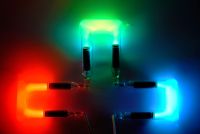
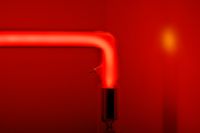
The discharge lamp shown here has a straight 1.75 m-long section terminated by 35 mA cold hollow electrodes that are placed at a right angle and is filled with a neon-argon Penning mix. This particular configuration allows an interesting observation: the difference in light color along the discharge axis compared to that elsewhere. This can be clearly seen in the picture above where the light cumulated along the axis and projected onto a piece of paper results in a distinctly yellow-orange spot while the lamp emits red light overall. This change in color is caused by a highly selective optical absorption that takes place in the neon plasma. This arises from the fact that the long-wave part of Ne's spectral emission comes from energetic transitions that terminate on the 3s³P₀ and 3s³P₂ levels which are metastable (i.e., long lived), meaning that there are plenty of atoms in those states available in the plasma to re-absorb photons with a wavelength ranging from 588.2 to 703.2 nm (orange-red). Other lines in the green and yellow part of the spectrum (and also some red) originate from transitions that end on the non-metastable 3s¹P₁ and 3s³P₁ states, which means that there are far less neon atoms in those states available in the discharge to reabsorb that particular light. The consequence is that orange-red light is strongly dampened along the lamp's axis while yellow and green light travels much more freely, resulting in the observed color shift.


Keywords: Lamps

RLOD#54 (2020.12.31) Late-1950s Janse Lichtreclame N58680

The discharge lamp shown here has a straight 1.75 m-long section terminated by 35 mA cold hollow electrodes that are placed at a right angle and is filled with a neon-argon Penning mix. This particular configuration allows an interesting observation: the difference in light color along the discharge axis compared to that elsewhere. This can be clearly seen in the picture above where the light cumulated along the axis and projected onto a piece of paper results in a distinctly yellow-orange spot while the lamp emits red light overall. This change in color is caused by a highly selective optical absorption that takes place in the neon plasma. This arises from the fact that the long-wave part of Ne's spectral emission comes from energetic transitions that terminate on the 3s³P₀ and 3s³P₂ levels which are metastable (i.e., long lived), meaning that there are plenty of atoms in those states available in the plasma to re-absorb photons with a wavelength ranging from 588.2 to 703.2 nm (orange-red). Other lines in the green and yellow part of the spectrum (and also some red) originate from transitions that end on the non-metastable 3s¹P₁ and 3s³P₁ states, which means that there are far less neon atoms in those states available in the discharge to reabsorb that particular light. The consequence is that orange-red light is strongly dampened along the lamp's axis while yellow and green light travels much more freely, resulting in the observed color shift.

2021-01-02_Gazosvet_GR-10.jpg 2020-12-31_Janse_Lichtreclame_N58680.jpg 2020-11-29_Silec_V200.jpg 2020-11-13_Janse_Lichtreclame_10-76133.jpg 2020-09-27_Philips_FNF_50W.jpg
Lamp/Fixture Information
Manufacturer:Janse Lichtreclame (Philips license)
Model Reference:N58680
Lamp
Lamp Type:Neon low pressure, high-voltage type
Filament/Radiator Type:Nonthermal discharge in neon and argon (Penning mixture)
Base:Screw lugs
Shape/Finish:Tubular clear
Service Life:c. 100 kh
Burning Position:Universal
Electrical
Current:35 mA
Physical/Production
Dimensions:1750L x 130W mm (17.4 mm Ø)
Factory Location:Eindhoven, the Netherlands
Fabrication Date:Late 1950s
Application/Use:Demonstration
File information
Filename:2020-12-31_Janse_Lichtreclame_N58680.jpg
Album name:Max / Random lamp of the day
Keywords:Lamps
Filesize:237 KiB
Date added:20 Nov 2026
Dimensions:1200 x 800 pixels
Displayed:16 times
URL:https://trad-lighting.net/gallery/displayimage.php?pid=1466
Favourites:Remove from Favourites

Comment 1 to 4 of 4
Page: 1

Drew   [Fri 20 Nov 2026 at 14:22]
What a neat effect!! Very cool observation, I never thought that the plasma of a gas would absorb one part of its emission more than another part but that totally makes sense.
Tuopeek   [Fri 20 Nov 2026 at 16:58]
Almost looks like it’s lazing, if the dot wasn’t so fuzzy. Is this also demonstrating the radial electron energy distribution in the discharge, where different electron transitions in the gas are occurring across the radius
of the discharge?
Ria   [Fri 20 Nov 2026 at 20:33]
This is wonderful to see, another gem from our Max Cool Love
Max   [Sat 21 Nov 2026 at 08:26]
You're very welcome, Ria Smile

Tuopeek - There's no chance of lasing with such lossy end "mirrors" here Wink To answer your second question, that little experiment does not really show any difference in electron energy across the radial direction of the discharge. First of all because the exact light color distribution across radius is not actually imaged on the paper surface... there is no imaging optics involved here. Secondly, the general color aspect of the projected orange spot is very different from the red color seen on the side of the discharge, which points at a physical phenomenon which is related specifically to length rather than radius. Third, and finally, the color aspect of the discharge as seen side-on in the picture above does not show any significant differences beween the axis and zones near the wall. If any conclusion is to be drawn from the picture as far as the radius-dependence of the plasma's electron energy is concerned, it's that it's quite constant, or that changes vs. radius are not significant enough to result in clearly visible light color differences.

Drew - Plasmas do not only emit light, they are very much absorbent of it as well. And like they do not radiate different wavelengths equally, they certainly do not absorb them equally too. It's the balance between emission and absorption over the wavelengths and over all photon paths in the lamp volume which result in the total lamp spectrum as observed on the outside.

Emission and absorption of light is also a form of energy transfer which can affect the thermal properties of certain plasmas, such as those of metal halide lamps. The hot arc core in those lamps radiates mostly around mercury's resonant transitions at 185 and 254 nm, so this optical energy is re-absorbed for a large part by the colder outer vapor mantle where elemental mercury is also present, which results in a broadened arc temperature profile. Remove mercury and the arc becomes very contracted. The radiation from the metal additives (sodium, thallium, rare earths, etc) is much less re-absorbed because in the colder outer mantle those additives are recombined into halide molecules whose optical properties are very different from those of the atoms.

This optical transfer of energy can also result in the fluorescence of gases and vapors, which is the case in low-pressure sodium and mercury lamps, where the process is a resonant one. This matter of optical emission and absorption in lighting plasmas is certainly not a simple one and its effects are very real and significant in lamps.

Comment 1 to 4 of 4
Page: 1