Photo Gallery

Early-1990s NAFA CoolBeam 100W

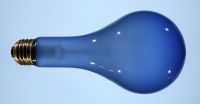
The CoolBeam 100W shown here was made in the late 1990s by Toshiba of Japan as an economical alternative to dichroic-reflector PAR38 lamps. In order to reduce the forward infrared output of the lamp, the Japanese developed a clever engineering solution: a heat-absorbing front plate made of a special borosilicate glass material with cobalt, iron and nickel dopants, formulated for an optimum broad-band absorption of near infrared radiation. This plate is also coated on the outside with a thick layer of indium-tin oxide, ITO, the semi-conductor material used as an IR-reflector in low-pressure sodium lamps. The main reflector remained coated with aluminum.

Interestingly the glass plate appears to contain neodymium as well, a dopant which is not present in the standard variant of the lamp sold in Japan. This additive is a strong absorbent of yellow-orange light (beside some narrow bands in the near infrared), which results in a higher light color temperature and in more saturated primary colors, optical characteristics that are used to great effect in the illumination of foodstuff (bread, meat, vegetables).

Toshiba introduced this particular lamp around 1987‒89, following the company’s reflector lamp upgrade in the mid-1980s with new pressed-glass tooling and improved vacuum coating equipment. This coincided with the retail lighting boom of the 1980s which called for specialized light sources with e.g. improved beam characteristics, reduced heat output, etc. While the CoolBeam PAR lamp was made at Toshiba’s Kanuma plant (Tochigi prefecture), the company’s main lamp-manufacturing base, it was distributed in northern Europe by NAFA, a lighting equipment distributor established in the Benelux in the late 1980s. That company focused on high-quality retail lighting applications (high CRI, low UV, etc.) and traded rebranded OEM-produced high-end incandescent and discharge lamps. Sometimes they even specified certain unique characteristics for their lamps, and that may be the reason for the presence of neodymium in the present lamp. NAFA eventually ceased operations in the early 2000s (there were unrelated brand successors in Switzerland and Germany). Toshiba kept on producing CoolBeam PAR lamps, both in standard (shown here) and halogen types. Due to its lesser efficacy, the former type was eventually phased out just before the mid-2000s (still with the design shown here, minus neodymium).


Keywords: Lamps

Early-1990s NAFA CoolBeam 100W


The CoolBeam 100W shown here was made in the late 1990s by Toshiba of Japan as an economical alternative to dichroic-reflector PAR38 lamps. In order to reduce the forward infrared output of the lamp, the Japanese developed a clever engineering solution: a heat-absorbing front plate made of a special borosilicate glass material with cobalt, iron and nickel dopants, formulated for an optimum broad-band absorption of near infrared radiation. This plate is also coated on the outside with a thick layer of indium-tin oxide, ITO, the semi-conductor material used as an IR-reflector in low-pressure sodium lamps. The main reflector remained coated with aluminum.

Interestingly the glass plate appears to contain neodymium as well, a dopant which is not present in the standard variant of the lamp sold in Japan. This additive is a strong absorbent of yellow-orange light (beside some narrow bands in the near infrared), which results in a higher light color temperature and in more saturated primary colors, optical characteristics that are used to great effect in the illumination of foodstuff (bread, meat, vegetables).

Toshiba introduced this particular lamp around 1987‒89, following the company’s reflector lamp upgrade in the mid-1980s with new pressed-glass tooling and improved vacuum coating equipment. This coincided with the retail lighting boom of the 1980s which called for specialized light sources with e.g. improved beam characteristics, reduced heat output, etc. While the CoolBeam PAR lamp was made at Toshiba’s Kanuma plant (Tochigi prefecture), the company’s main lamp-manufacturing base, it was distributed in northern Europe by NAFA, a lighting equipment distributor established in the Benelux in the late 1980s. That company focused on high-quality retail lighting applications (high CRI, low UV, etc.) and traded rebranded OEM-produced high-end incandescent and discharge lamps. Sometimes they even specified certain unique characteristics for their lamps, and that may be the reason for the presence of neodymium in the present lamp. NAFA eventually ceased operations in the early 2000s (there were unrelated brand successors in Switzerland and Germany). Toshiba kept on producing CoolBeam PAR lamps, both in standard (shown here) and halogen types. Due to its lesser efficacy, the former type was eventually phased out just before the mid-2000s (still with the design shown here, minus neodymium).

Nafa_CoolBeam_100W_-_JP_l_90s.jpg Wabash_Superflood_N_B2_500W_120V_-_USA_1940s.jpg Sylvania_50ER95_-_F_m1980s.jpg Philips_12342_H4_602155W_12V_clear_-_FRG_1987.jpg Sylvania_FNF_50W_Blue_-_BE_1991_a.jpg
Lamp/Fixture Information
Manufacturer:Toshiba
Model Reference:CoolBeam 100W
Lamp
Lamp Type:Incandescent filtered
Filament/Radiator Type:Incandescent tungsten filament
Base:E27
Shape/Finish:PAR with heat-absorbring front plate
Service Life:2 kh
Burning Position:Universal
Electrical
Wattage:100 W
Voltage:230 V
Current:0.43 A
Optical
Lumen Output:1450 lm
Lumen Efficacy:14.5 lm/W
Colour Temperature:3150 K
Colour Rendering Index:~80 Ra8
Physical/Production
Dimensions:136L x 122Ø mm
Factory Location:Kanuma, Tochigi prefecture, Japan
Fabrication Date:Early 1990s
Application/Use:Food retail lighting
File information
Filename:Nafa_CoolBeam_100W_-_JP_l_90s.jpg
Album name:Max / Incandescent lamps
Keywords:Lamps
Filesize:1105 KiB
Date added:02 Feb 2026
Dimensions:1500 x 1500 pixels
Displayed:69 times
DateTime Original:2013:12:15 02:21:12
Exposure Time:1/30 sec
FNumber:f/8
Flash:No Flash
Focal length:65 mm
ISO:1000
Model:Canon EOS 6D
Software:Adobe Photoshop CS5 Windows
White Balance:1
URL:https://trad-lighting.net/gallery/displayimage.php?pid=1106
Favourites:Add to Favourites

Comment 1 to 6 of 6
Page: 1

Tuopeek   [Sat 07 Feb 2026 at 15:09]
I imagine the front plate must run very hot compared to normal 100w PAR. I once used a 70w SON/R to replace a PAR spot outside, it was great but didn't survive thermal shock from the elements despite having a cowl to keep rain off the outer glass.
Ria   [Sun 08 Feb 2026 at 01:50]
Pity you couldn't get one of these PAR lamp Cool
Max   [Sun 08 Feb 2026 at 10:25]
Good point about the temperature of the front glass! It must be quite hot indeed, and that lamp is most likely not suitable for an outdoor usage, exposed to the elements, given that the extra dopant have certainly reduced the softening temperature of that glass material and made it not as weather resistant as plain borosilicate. About your SON/R 70W, does (did) it have a blown bulb like in standard incandescent reflector lamps? If so, then it's very likely that it was made with a soft soda-lime glass.
Tuopeek   [Sun 08 Feb 2026 at 11:39]
Yes, indeed Max, I think I knew my SON/R wasn't suitable for out door use and had added a cowl for shielding. At the time I thought a glass front cover was also really needed. That's was going to be difficult to make so unfortunately risked the lamp which broke during some wild wet weather. It was a bit of a shame as the Thorn 70w SON/R I was using got discontinued quite quickly.
Max   [Sun 08 Feb 2026 at 12:23]
That's a shame indeed! Things are always obvious in hindsight, but in the moment we always take the decisions we think are the best ones given the information we have. Sometimes it's just a gamble and it doesn't pan out the way we expected.

An interesting example I have in mind is that of a pair of integral-ballasted Philips CDMi 25W PAR38 that I gave my father about 15 years ago. Not knowing its limitations, he installed one of them in an outside wall luminaire with a PIR sensor (set with a relatively long on time, about 10-15 min)... These lamps are not weather sealed and switching them on and off frequently is certainly the worst way to use them. Long story short, it's been more than 10 years now and that lamp is still doing fine and the spare is still waiting for its turn... and I get reminded how wrong I was that it would die so quickly Laughing.
Tuopeek   [Sun 08 Feb 2026 at 14:26]
I wouldn't have expected the switching cycle and exposure to result in a short lamp life there too. Just shows, it can work out better than expected.

Comment 1 to 6 of 6
Page: 1