Photo Gallery

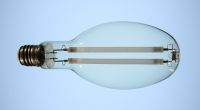
2007 Osram HQI-TS 250W/WDL

As the originator of the compact double-ended quartz metal halide lamp, Osram strove to deliver the best balance between quality, performance, and durability in order to create a market for themselves in the shop-and-retail lighting segment. Since the introduction of their first compact HQI-TS in 1982, a 70 W warm-white type aimed at applications that used the 300 W linear tungsten halogen lamp, the company developed an extensive range of discharge lamps ranging from 70 to 250 W, with three light colors available: warm white (WDL), neutral white (NDL), and daylight (D). First introduced in the early 1990s, the 250 W WDL type was the last model added to this product portfolio. For that lamp they used their existing 250 W MH burner platform, filled with a sodium-thallium-indium-tin salt mix instead of the usual rare-earth fill chemistry employed in /NDL and /D variants.

By the 2000s Osram faced some fierce competition, both from other manufacturers who had caught up and offered their own versions of the HQI-TS, and from ceramic variants of their lamps, a technology first introduced by Philips in 1994. As a result they overhauled their whole low-wattage HQI-TS portfolio so as to maintain a competitive edge. The HQI-TS 250W/WDL was improved with a new burner design featuring a single quartz tube shaped using a fully automated lathe process that was initially developed for special short-arc lamps. While the fill chemistry remained the same Na-Tl-In-Sn iodide mix, the electrode gap length was reduced to 10 mm (was 27 mm) in order to increase the discharge power load to 225 W/cm (was 85 W/cm). This change, combined with a higher mercury buffer pressure, has the effect of reducing the total heat conduction losses from the plasma, which raised the luminous flux from 20 to 22 klm, matching that of the 1000 W linear tungsten halogen lamp.

The nature of the quartz used in the new lamp was also changed to a high-purity fused silica material, which allowed a stable burner operation at a higher overall temperature. This and the shorter arc made the use of heat-conserving end coatings unnecessary, which simplified the lamp production process. Despite a higher wall loading, the mean service life was increased from 10 to 12 kh. This was made possible by a very carefully controlled chemistry combined with a homogeneous temperature profile of the arc tube, facilitated by the short electrode distance which reduces the effect of discharge arching on the vessel's temperature distribution.

As opposed to its warm-white 70-150 W HQI-TS, Osram did not upgrade the 250 W model to a rare earth fill chemistry. Two possible reasons for this are that they certainly needed the less aggressive halide additives given the burner's high wall temperature, and tin halides are much more volatile than rare earth ones. The latter point is particular important in view of the high discharge power load and the high mercury pressure, which both set the requirement for a particularly high additive vapor pressure in order to produce visible light efficiently. Moreover, the high wall and electrode temperatures necessitate a high halogen partial pressure in order to maintain a reasonably active tungsten-halogen cycle to limit the rate of burner blackening. The use of less volatile rare earth additives would certainly have required a too high burner temperature in order to obtain similar light-technical properties.

Finally, it is interesting to note that tin-based fill chemistries are usually less efficient than those based on rare earth halides. This is due to a significantly higher infrared emission from the arc, originating primarily from tin mono-halide molecules present in the hot plasma. Despite such limitation Osram still managed to realize an initial lumen efficacy of 88 lm/W with its upgraded HQI-TS 250W/WDL, a figure that is slightly higher than that of /NDL and /D variants (86 lm/W) which are filled with rare earth halides. The combination of a shorter arc with higher mercury and salt vapor pressures proved effective in reducing thermal and radiative losses from the hot tin halide plasma.


Keywords: Lamps

2007 Osram HQI-TS 250W/WDL


As the originator of the compact double-ended quartz metal halide lamp, Osram strove to deliver the best balance between quality, performance, and durability in order to create a market for themselves in the shop-and-retail lighting segment. Since the introduction of their first compact HQI-TS in 1982, a 70 W warm-white type aimed at applications that used the 300 W linear tungsten halogen lamp, the company developed an extensive range of discharge lamps ranging from 70 to 250 W, with three light colors available: warm white (WDL), neutral white (NDL), and daylight (D). First introduced in the early 1990s, the 250 W WDL type was the last model added to this product portfolio. For that lamp they used their existing 250 W MH burner platform, filled with a sodium-thallium-indium-tin salt mix instead of the usual rare-earth fill chemistry employed in /NDL and /D variants.

By the 2000s Osram faced some fierce competition, both from other manufacturers who had caught up and offered their own versions of the HQI-TS, and from ceramic variants of their lamps, a technology first introduced by Philips in 1994. As a result they overhauled their whole low-wattage HQI-TS portfolio so as to maintain a competitive edge. The HQI-TS 250W/WDL was improved with a new burner design featuring a single quartz tube shaped using a fully automated lathe process that was initially developed for special short-arc lamps. While the fill chemistry remained the same Na-Tl-In-Sn iodide mix, the electrode gap length was reduced to 10 mm (was 27 mm) in order to increase the discharge power load to 225 W/cm (was 85 W/cm). This change, combined with a higher mercury buffer pressure, has the effect of reducing the total heat conduction losses from the plasma, which raised the luminous flux from 20 to 22 klm, matching that of the 1000 W linear tungsten halogen lamp.

The nature of the quartz used in the new lamp was also changed to a high-purity fused silica material, which allowed a stable burner operation at a higher overall temperature. This and the shorter arc made the use of heat-conserving end coatings unnecessary, which simplified the lamp production process. Despite a higher wall loading, the mean service life was increased from 10 to 12 kh. This was made possible by a very carefully controlled chemistry combined with a homogeneous temperature profile of the arc tube, facilitated by the short electrode distance which reduces the effect of discharge arching on the vessel's temperature distribution.

As opposed to its warm-white 70-150 W HQI-TS, Osram did not upgrade the 250 W model to a rare earth fill chemistry. Two possible reasons for this are that they certainly needed the less aggressive halide additives given the burner's high wall temperature, and tin halides are much more volatile than rare earth ones. The latter point is particular important in view of the high discharge power load and the high mercury pressure, which both set the requirement for a particularly high additive vapor pressure in order to produce visible light efficiently. Moreover, the high wall and electrode temperatures necessitate a high halogen partial pressure in order to maintain a reasonably active tungsten-halogen cycle to limit the rate of burner blackening. The use of less volatile rare earth additives would certainly have required a too high burner temperature in order to obtain similar light-technical properties.

Finally, it is interesting to note that tin-based fill chemistries are usually less efficient than those based on rare earth halides. This is due to a significantly higher infrared emission from the arc, originating primarily from tin mono-halide molecules present in the hot plasma. Despite such limitation Osram still managed to realize an initial lumen efficacy of 88 lm/W with its upgraded HQI-TS 250W/WDL, a figure that is slightly higher than that of /NDL and /D variants (86 lm/W) which are filled with rare earth halides. The combination of a shorter arc with higher mercury and salt vapor pressures proved effective in reducing thermal and radiative losses from the hot tin halide plasma.

Osram_HQI-TS_250W21WDL_-_D_2007.jpg Mazda_MAF_700W_RV_-_FR_1972_a.jpg Philips_C150021ED37_-_USA_1993.jpg Philips_DUV35_-_D_2001.jpg Tesla_RVY_250W_-_CZK_1969.jpg
Lamp/Fixture Information
Manufacturer:Osram
Model Reference:HQI-TS 250W/WDL
Lamp
Lamp Type:Quartz metal halide
Filament/Radiator Type:Thermal discharge in argon, mercury, and metal halide vapors (Sn, In, Tl, Na)
Base:Fc2
Shape/Finish:Tubular clear
Service Life:12 kh
Burning Position:Horizontal ±45°
Electrical
Wattage:250 W
Voltage:104 V
Current:2.8 A
Optical
Lumen Output:22.0 / 14.3 klm (initial / mean)
Lumen Efficacy:88.0 / 57.2 lm/W (initial / mean)
Colour Temperature:3200 K
Colour Rendering Index:80 Ra8
Physical/Production
Dimensions:162L x 27Ø mm
Factory Location:Berlin Spandau, Germany
Fabrication Date:November 2007
Application/Use:General lighting
File information
Filename:Osram_HQI-TS_250W21WDL_-_D_2007.jpg
Album name:Max / Thermal discharge lamps
Keywords:Lamps
Filesize:52 KiB
Date added:07 Jan 2026
Dimensions:1500 x 580 pixels
Displayed:216 times
DateTime Original:2017:02:05 19:59:52
URL:https://trad-lighting.net/gallery/displayimage.php?pid=1081
Favourites:Add to Favourites

Comment 1 to 2 of 2
Page: 1

Tuopeek   [Wed 07 Jan 2026 at 18:40]
I have an Osram HQI-TS 250W/NDL in my collection and it is interesting to see how much smaller the discharge tube is in your lamp. It would appear the arc length is more than half that of the NDL and a lot smaller envelope.
Max   [Thu 08 Jan 2026 at 11:38]
You're right, it's not only the electrode gap distance which has been shortened, the burner diameter is quite smaller too. The arc tube must be operating at a considerably higher average temperature given the significant increase in volumetric power density. This probably explains why that lamp's flux maintenance is mediocre (65 % mean).

Comment 1 to 2 of 2
Page: 1