|
|
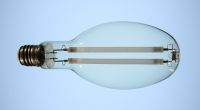
1972 Mazda MAF 700W RV
|
The 700 W high-pressure mercury vapor lamp was commonly used in France between the 1960s and 1980s to illuminate large areas in industrial and roadway applications. Like Philips, the Compagnie des Lampes (Mazda) introduced its first 700 W mercury lamp in 1960 as a light source of intermediate output between those of its 400 and 1000 W siblings, which were both road, industrial, and outdoors lighting workhorses at the time. However, Mazda was the only one to offer both fluorescent and clear variants of all these lamps. The former type was aimed at long-range floodlighting where light color quality is not critical. These uncorrected lamps were eventually delisted following the introduction in the second half of the 1960s of the high-pressure sodium and metal halide lamps. Clear 700 W mercury lamps then remained available upon special request only and the color-corrected fluorescent type became de facto standard, intended primarily for a use in high-bay and streetlight luminaires.
The first 700 W fluorescent mercury lamp from Philips and Mazda was released with a coating of manganese-activated magnesium arsenate phosphor, upgraded to europium-activated yttrium vanadate in 1968 (there was a technical cooperation agreement between both companies), which improved both light output and color. The MAF 700W RV shown here is a latter variant produced in France and coated with Philips’s highly efficient and stable yttrium vanadate phosphate borate phosphor which raised the initial lumen output to 42 klm. These ameliorations are reflected in the “RV” suffix in the lamp reference, which means “Revètement Vanadate”, a mention that was eventually removed in the early 1980s as this fluorescent technology had become a standard. The lamp also bears the old Ahura Mazda logo of the Compagnie des Lampes, a Zoroastrian imagery symbolizing light and wisdom. Typical of medium- and high-wattage mercury lamps produced by this company, (like Philips' lamps) this model features a quartz burner provided with two ignition probes that ensures a reliable discharge ignition under all weather conditions, especially the coldest ones.

The use of large mercury lamps waned during the 1980s as more efficient high-pressure sodium lamps became the preferred choice in utilitarian lighting applications, especially in the 250 and 400 W ratings, the latter providing more light than the 700 W mercury lamp. Mercury luminaires rated above 400 W were more affected by this transition because of the higher cost price of high-wattage lamps which were produced in smaller quantities than their low-wattage counterparts. The difference in power consumption for a given light output is also greater at higher wattages, which resulted in larger cost savings overall, especially considering the higher optical efficiency of sodium luminaires. All these effectively drove large mercury lamp systems to their extinction.
|
|


 Forum
Forum Gallery Home
 Contact
 Login
Login Off-Topic
 Album list
 Last uploads
 Last comments
 Most viewed
 Top rated
 My Favourites
 Search
![1972 Mazda MAF 700W RV
The 700 W high-pressure mercury vapor lamp was commonly used in France between the 1960s and 1980s to illuminate large areas in industrial and roadway applications. Like Philips, the Compagnie des Lampes (Mazda) introduced its first 700 W mercury lamp in 1960 as a light source of intermediate output between those of its 400 and 1000 W siblings, which were both road, industrial, and outdoors lighting workhorses at the time. However, Mazda was the only one to offer both fluorescent and clear variants of all these lamps. The former type was aimed at long-range floodlighting where light color quality is not critical. These uncorrected lamps were eventually delisted following the introduction in the second half of the 1960s of the high-pressure sodium and metal halide lamps. Clear 700 W mercury lamps then remained available upon special request only and the color-corrected fluorescent type became de facto standard, intended primarily for a use in high-bay and streetlight luminaires.
The first 700 W fluorescent mercury lamp from Philips and Mazda was released with a coating of manganese-activated magnesium arsenate phosphor, upgraded to europium-activated yttrium vanadate in 1968 (there was a technical cooperation agreement between both companies), which improved both light output and color. The MAF 700W RV shown here is a latter variant produced in France and coated with Philips’s highly efficient and stable yttrium vanadate phosphate borate phosphor which raised the initial lumen output to 42 klm. These ameliorations are reflected in the “RV” suffix in the lamp reference, which means “Revètement Vanadate”, a mention that was eventually removed in the early 1980s as this fluorescent technology had become a standard. The lamp also bears the old Ahura Mazda logo of the Compagnie des Lampes, a Zoroastrian imagery symbolizing light and wisdom. Typical of medium- and high-wattage mercury lamps produced by this company, (like Philips' lamps) this model features a quartz burner provided with two ignition probes that ensures a reliable discharge ignition under all weather conditions, especially the coldest ones.
[img]https://i.ibb.co/qqb9FsP/Mazda-MAF-700-W-RV-FR-1972-b.jpg[/img]
The use of large mercury lamps waned during the 1980s as more efficient high-pressure sodium lamps became the preferred choice in utilitarian lighting applications, especially in the 250 and 400 W ratings, the latter providing more light than the 700 W mercury lamp. Mercury luminaires rated above 400 W were more affected by this transition because of the higher cost price of high-wattage lamps which were produced in smaller quantities than their low-wattage counterparts. The difference in power consumption for a given light output is also greater at higher wattages, which resulted in larger cost savings overall, especially considering the higher optical efficiency of sodium luminaires. All these effectively drove large mercury lamp systems to their extinction.
Keywords: Lamps](albums/userpics/10005/8/normal_Mazda_MAF_700W_RV_-_FR_1972_a.jpg "Click to view full size image
==============
1972 Mazda MAF 700W RV
The 700 W high-pressure mercury vapor lamp was commonly used in France between the 1960s and 1980s to illuminate large areas in industrial and roadway applications. Like Philips, the Compagnie des Lampes (Mazda) introduced its first 700 W mercury lamp in 1960 as a light source of intermediate output between those of its 400 and 1000 W siblings, which were both road, industrial, and outdoors lighting workhorses at the time. However, Mazda was the only one to offer both fluorescent and clear variants of all these lamps. The former type was aimed at long-range floodlighting where light color quality is not critical. These uncorrected lamps were eventually delisted following the introduction in the second half of the 1960s of the high-pressure sodium and metal halide lamps. Clear 700 W mercury lamps then remained available upon special request only and the color-corrected fluorescent type became de facto standard, intended primarily for a use in high-bay and streetlight luminaires.
The first 700 W fluorescent mercury lamp from Philips and Mazda was released with a coating of manganese-activated magnesium arsenate phosphor, upgraded to europium-activated yttrium vanadate in 1968 (there was a technical cooperation agreement between both companies), which improved both light output and color. The MAF 700W RV shown here is a latter variant produced in France and coated with Philips’s highly efficient and stable yttrium vanadate phosphate borate phosphor which raised the initial lumen output to 42 klm. These ameliorations are reflected in the “RV” suffix in the lamp reference, which means “Revètement Vanadate”, a mention that was eventually removed in the early 1980s as this fluorescent technology had become a standard. The lamp also bears the old Ahura Mazda logo of the Compagnie des Lampes, a Zoroastrian imagery symbolizing light and wisdom. Typical of medium- and high-wattage mercury lamps produced by this company, (like Philips' lamps) this model features a quartz burner provided with two ignition probes that ensures a reliable discharge ignition under all weather conditions, especially the coldest ones.
[img]https://i.ibb.co/qqb9FsP/Mazda-MAF-700-W-RV-FR-1972-b.jpg[/img]
The use of large mercury lamps waned during the 1980s as more efficient high-pressure sodium lamps became the preferred choice in utilitarian lighting applications, especially in the 250 and 400 W ratings, the latter providing more light than the 700 W mercury lamp. Mercury luminaires rated above 400 W were more affected by this transition because of the higher cost price of high-wattage lamps which were produced in smaller quantities than their low-wattage counterparts. The difference in power consumption for a given light output is also greater at higher wattages, which resulted in larger cost savings overall, especially considering the higher optical efficiency of sodium luminaires. All these effectively drove large mercury lamp systems to their extinction.
Keywords: Lamps")