Photo Gallery

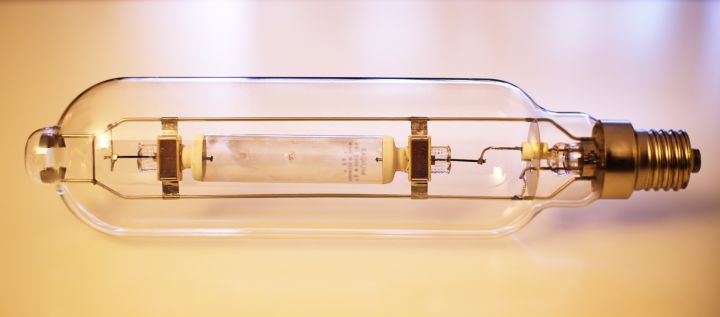
RLOD#43 (2020.07.24) 1975 Radium HRI 2000W D1

Radium and Osram of West Germany began developing high-wattage daylight metal halide lamps for general lighting applications in 1967 using a newly formulated triple rare earth fill chemistry suitable for high arc power loads. The 2 kW model featured here was introduced in 1970 and was optimized to the listed specifications the following year. In order to obtain properly high performances the electrode gap length was shortened to 105 mm so as to raise the arc power load to 170 W/cm, which is about 40 % higher than in the earlier neutral-white version of the lamp, introduced in 1964. This not only reduces the heat conduction losses of the arc, resulting in an 85 lm/W efficacy, this also raised the mean source luminance to 920 cd/cm², 74 % higher than in the neutral-white lamp, thereby enabling a much more effective optical control of the emitted light. Combined to that, the lamp's Tl-Dy-Ho-Tm/Cs fill chemistry delivers a light color of near daylight quality, which made this type of light source highly popular in professional sports lighting, especially where color TV broadcasting was involved. As a matter of fact, the primary motivation for the release of these large daylight metal halide lamps was the 1972 summer Olympic Games in Munich.


Keywords: Lamps

RLOD#43 (2020.07.24) 1975 Radium HRI 2000W D1


Radium and Osram of West Germany began developing high-wattage daylight metal halide lamps for general lighting applications in 1967 using a newly formulated triple rare earth fill chemistry suitable for high arc power loads. The 2 kW model featured here was introduced in 1970 and was optimized to the listed specifications the following year. In order to obtain properly high performances the electrode gap length was shortened to 105 mm so as to raise the arc power load to 170 W/cm, which is about 40 % higher than in the earlier neutral-white version of the lamp, introduced in 1964. This not only reduces the heat conduction losses of the arc, resulting in an 85 lm/W efficacy, this also raised the mean source luminance to 920 cd/cm², 74 % higher than in the neutral-white lamp, thereby enabling a much more effective optical control of the emitted light. Combined to that, the lamp's Tl-Dy-Ho-Tm/Cs fill chemistry delivers a light color of near daylight quality, which made this type of light source highly popular in professional sports lighting, especially where color TV broadcasting was involved. As a matter of fact, the primary motivation for the release of these large daylight metal halide lamps was the 1972 summer Olympic Games in Munich.

2020-07-24_Radium_HRI_2000W_D1.jpg 2020-07-20_Thorn_CID_2500W.jpg DSC_1538m.jpg Westinghouse.jpg Letter_Opener.jpg
Lamp/Fixture Information
Manufacturer:Radium
Model Reference:HRI 2000W D1
Lamp
Lamp Type:Quartz metal halide
Filament/Radiator Type:Thermal discharge in argon, mercury, and metal iodides (Tl, Dy, Ho, Tm, Cs)
Base:E40s
Shape/Finish:Tubular clear
Service Life:2000 h
Burning Position:Horizontal ±60°
Electrical
Wattage:2000 W
Voltage:230 V
Current:10 A
Optical
Lumen Output:170 klm (initial)
Lumen Efficacy:85 lm/W (initial)
Colour Temperature:6000 K
Colour Rendering Index:93 Ra8
Physical/Production
Dimensions:430L x 100Ø mm
Factory Location:Wipperfürth, FRG
Fabrication Date:May 1975
Application/Use:Sports and general flood lighting
File information
Filename:2020-07-24_Radium_HRI_2000W_D1.jpg
Album name:Max / Random lamp of the day
Keywords:Lamps
Filesize:374 KiB
Date added:11 Aug 2026
Dimensions:1500 x 661 pixels
Displayed:3 times
URL:https://trad-lighting.net/gallery/displayimage.php?pid=1387
Favourites:Add to Favourites