|
|
"Lab-Arc" GE NA-1 Sodium Spectral Lamp
|
This is a used example of a General Electric sodium "Lab-Arc" NA-1 lamp, these are a very old design that I believe was first made in 1933 (possibly earlier). This lamp is additionally labeled "G5CL" on the label on the base. I am not familiar with date codes on lamps but the "57" on this lamp might mean something with regards to its manufacturing date.
This lamp uses an external dewar jacket for thermal insulation, and needs difficult to find control gear to run properly. I run it on a George W. Gates SLA-5C, which I may upload later once I take better pictures of it. As far as I am aware it works similarly to American rapid-start fluorescent lamps. It uses constant cathode heating during its operation, and only strikes the discharge after the electrodes have become emissive enough for it to do so. The open circuit voltage across the electrodes is only around 25V, so unsurprisingly it can sometimes take a while to strike.
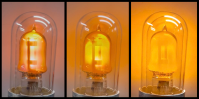
Once it does strike, the initial discharge of the fill gas is light purple. I have not confirmed this to be argon with a spectroscope yet, but it looks very much like it. This lamp takes around 15 minutes to warm up, and is surprisingly bright. All that is visible is just an opaque cloud of yellow that fills the upper envelope, you can't really see the electrode structures.
Like I said, this lamp is used, and it definitely shows. The glass tubing shrouding the lead wires for the distal electrode are very brown from sodium attack, and even the borosilicate wall of the discharge tube (protected with some sort of sodium resistant glass glaze) are starting to brown. Also seen here is a sodium film that has migrated down into the lower separated envelope containing the pinch seal.
The construction of these early American lamps is very interesting, it really shows you how much thought had to go into LPS technology to eventually get to the highly refined SOX-E design. They look so simple from afar, but every aspect of them is a work of art really.
|
|


 Forum
Forum Gallery Home
 Contact
 Login
Login Off-Topic
 Album list
 Last uploads
 Last comments
 Most viewed
 Top rated
 My Favourites
 Search




Welcome to the site, by the way