|
|
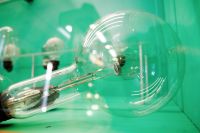
1958 Philips HO 250W
|
The use of quartz in place of hard glass in high-pressure mercury lamps enables an operation at higher temperature and pressure, whose benefits include a higher lumen efficacy, an enhanced spectral output in the red, and the possibility to operate lamps at all positions. Although both types of mercury lamps were invented just a few years apart during the 1930s, the higher cost of fused quartz has initially greatly limited its uses. As a result, hard-glass lamps prevailed during the 1930s and 40s while fused quartz was used only when strictly necessary, such as at the lowest (<250 W) and highest wattages (1 kW), which was a niche market at the time.
The generalization of quartz burners began in the USA where the mass production of 250 and 400 W lamps using this vessel began in the early 1940s. In Europe, this transition began a decade later and coincided with the introduction of manganese-activated phosphors, the first practical fluorescent materials for such lamps. Philips, in the Netherlands, released a range of HPL fluorescent mercury lamps with quartz burner in the early 1950s, but their high cost limited their usage to high-end applications only whereas their HO lamps with hard-glass burner and clear tubular jacket remained mostly unchallenged in utilitarian applications.
Because of the obvious advantages of a superatmospheric operation of the mercury arc in quartz vessels, lamp manufacturers worked relentlessly to improve their production of fused silica tubing. A significant cost reduction eventually led Philips to upgrade their HO lamps in 1958 with quartz burners. The very first modified models, such as the one featured here, still bore the original reference which corresponded specifically to the old aluminosilicate burner technology. The spring coil that supports the inner frame, the graphite-coated brass end cap and its green mark are also parts and design features from the old lamp. The green mark was used in the Netherlands, in Germany and in France to indicate the need for a current-limiting ballast at a time when the use of such device was relatively new.
The lamp reference was changed to HP/T within a few months of production so as to reflect the improvement in technology. The upgrade in burner material permitted an increase of the mercury vapor pressure by a factor of five, which resulted in a more compact arc with reduced heat losses, leading to a 20 percent gain in lumen output. The new lamps were made with the same light center length as that of the previous HO models in order to ensure proper optical retrofits in existing installations, but the different arc geometry led nevertheless to changes in the optical pattern of the projected light, a minor issue given the improved lamp performances.
The quartz burner mounted in the present HO 250W is of the single-tube type with full-press moly seals, typical of Philips' third-generation design introduced in the early 1950s and first used in HPL lamps. The main electrodes consist of rod-coil tungsten structures impregnated with a thorium compound formulated for an efficient emission of electrons (see picture below showing the optical emission from sputtered electrode material during an early stage of the lamp's run up phase). Although the radioactivity of thorium helps with ignition, the discharge vessel is provided with two auxiliary probes so as to ensure a reliable starting of the lamp under all weather conditions, especially during cold winters. Typical of high-pressure mercury lamps of that time, its quartz material is of low purity and contains a relatively high density of metal particles and of dissolved gases, the latter being particularly evident by the number of hairline bubbles present in the drawn tube. This, plus the nature of the electrodes, caused a fast lumen depreciation over time and a relatively short service life. The characteristics of the new mercury lamp were nevertheless at the cutting edge (except for the light color quality) of the mid-20th century lighting technology.

By 1960 the range of HP/T lamps was completed with the 400 and 2000 W models, which led to a widespread use of the quartz-mercury lamps in the clear tubular format. Applications targeted areas where a precise optical control of light is needed and where light color is not critical, i.e., primarily floodlighting in yard and industrial settings. The quality of materials and processing improved also, which extended their durability and maintenance greatly. These lamps were sold until the mid-1980s, after which they were mostly phased out due to a greater use of the more efficient high-pressure sodium and metal-halide lamps.
|
|


 Forum
Forum Gallery Home
 Contact
 Login
Login Off-Topic
 Album list
 Last uploads
 Last comments
 Most viewed
 Top rated
 My Favourites
 Search
![1958 Philips HO 250W
The use of quartz in place of hard glass in high-pressure mercury lamps enables an operation at higher temperature and pressure, whose benefits include a higher lumen efficacy, an enhanced spectral output in the red, and the possibility to operate lamps at all positions. Although both types of mercury lamps were invented just a few years apart during the 1930s, the higher cost of fused quartz has initially greatly limited its uses. As a result, hard-glass lamps prevailed during the 1930s and 40s while fused quartz was used only when strictly necessary, such as at the lowest (<250 W) and highest wattages (1 kW), which was a niche market at the time.
The generalization of quartz burners began in the USA where the mass production of 250 and 400 W lamps using this vessel began in the early 1940s. In Europe, this transition began a decade later and coincided with the introduction of manganese-activated phosphors, the first practical fluorescent materials for such lamps. Philips, in the Netherlands, released a range of HPL fluorescent mercury lamps with quartz burner in the early 1950s, but their high cost limited their usage to high-end applications only whereas their HO lamps with hard-glass burner and clear tubular jacket remained mostly unchallenged in utilitarian applications.
Because of the obvious advantages of a superatmospheric operation of the mercury arc in quartz vessels, lamp manufacturers worked relentlessly to improve their production of fused silica tubing. A significant cost reduction eventually led Philips to upgrade their HO lamps in 1958 with quartz burners. The very first modified models, such as the one featured here, still bore the original reference which corresponded specifically to the old aluminosilicate burner technology. The spring coil that supports the inner frame, the graphite-coated brass end cap and its green mark are also parts and design features from the old lamp. The green mark was used in the Netherlands, in Germany and in France to indicate the need for a current-limiting ballast at a time when the use of such device was relatively new.
The lamp reference was changed to HP/T within a few months of production so as to reflect the improvement in technology. The upgrade in burner material permitted an increase of the mercury vapor pressure by a factor of five, which resulted in a more compact arc with reduced heat losses, leading to a 20 percent gain in lumen output. The new lamps were made with the same light center length as that of the previous HO models in order to ensure proper optical retrofits in existing installations, but the different arc geometry led nevertheless to changes in the optical pattern of the projected light, a minor issue given the improved lamp performances.
The quartz burner mounted in the present HO 250W is of the single-tube type with full-press moly seals, typical of Philips' third-generation design introduced in the early 1950s and first used in HPL lamps. The main electrodes consist of rod-coil tungsten structures impregnated with a thorium compound formulated for an efficient emission of electrons (see picture below showing the optical emission from sputtered electrode material during an early stage of the lamp's run up phase). Although the radioactivity of thorium helps with ignition, the discharge vessel is provided with two auxiliary probes so as to ensure a reliable starting of the lamp under all weather conditions, especially during cold winters. Typical of high-pressure mercury lamps of that time, its quartz material is of low purity and contains a relatively high density of metal particles and of dissolved gases, the latter being particularly evident by the number of hairline bubbles present in the drawn tube. This, plus the nature of the electrodes, caused a fast lumen depreciation over time and a relatively short service life. The characteristics of the new mercury lamp were nevertheless at the cutting edge (except for the light color quality) of the mid-20th century lighting technology.
[img]https://i.ibb.co/ymqvtjHF/Philips-HO-250-W-NL-1958-b.jpg[/img]
By 1960 the range of HP/T lamps was completed with the 400 and 2000 W models, which led to a widespread use of the quartz-mercury lamps in the clear tubular format. Applications targeted areas where a precise optical control of light is needed and where light color is not critical, i.e., primarily floodlighting in yard and industrial settings. The quality of materials and processing improved also, which extended their durability and maintenance greatly. These lamps were sold until the mid-1980s, after which they were mostly phased out due to a greater use of the more efficient high-pressure sodium and metal-halide lamps.
Keywords: Lamps](albums/userpics/10005/8/normal_Philips_HO_250W_-_NL_1958_a.jpg "Click to view full size image
==============
1958 Philips HO 250W
The use of quartz in place of hard glass in high-pressure mercury lamps enables an operation at higher temperature and pressure, whose benefits include a higher lumen efficacy, an enhanced spectral output in the red, and the possibility to operate lamps at all positions. Although both types of mercury lamps were invented just a few years apart during the 1930s, the higher cost of fused quartz has initially greatly limited its uses. As a result, hard-glass lamps prevailed during the 1930s and 40s while fused quartz was used only when strictly necessary, such as at the lowest (<250 W) and highest wattages (1 kW), which was a niche market at the time.
The generalization of quartz burners began in the USA where the mass production of 250 and 400 W lamps using this vessel began in the early 1940s. In Europe, this transition began a decade later and coincided with the introduction of manganese-activated phosphors, the first practical fluorescent materials for such lamps. Philips, in the Netherlands, released a range of HPL fluorescent mercury lamps with quartz burner in the early 1950s, but their high cost limited their usage to high-end applications only whereas their HO lamps with hard-glass burner and clear tubular jacket remained mostly unchallenged in utilitarian applications.
Because of the obvious advantages of a superatmospheric operation of the mercury arc in quartz vessels, lamp manufacturers worked relentlessly to improve their production of fused silica tubing. A significant cost reduction eventually led Philips to upgrade their HO lamps in 1958 with quartz burners. The very first modified models, such as the one featured here, still bore the original reference which corresponded specifically to the old aluminosilicate burner technology. The spring coil that supports the inner frame, the graphite-coated brass end cap and its green mark are also parts and design features from the old lamp. The green mark was used in the Netherlands, in Germany and in France to indicate the need for a current-limiting ballast at a time when the use of such device was relatively new.
The lamp reference was changed to HP/T within a few months of production so as to reflect the improvement in technology. The upgrade in burner material permitted an increase of the mercury vapor pressure by a factor of five, which resulted in a more compact arc with reduced heat losses, leading to a 20 percent gain in lumen output. The new lamps were made with the same light center length as that of the previous HO models in order to ensure proper optical retrofits in existing installations, but the different arc geometry led nevertheless to changes in the optical pattern of the projected light, a minor issue given the improved lamp performances.
The quartz burner mounted in the present HO 250W is of the single-tube type with full-press moly seals, typical of Philips' third-generation design introduced in the early 1950s and first used in HPL lamps. The main electrodes consist of rod-coil tungsten structures impregnated with a thorium compound formulated for an efficient emission of electrons (see picture below showing the optical emission from sputtered electrode material during an early stage of the lamp's run up phase). Although the radioactivity of thorium helps with ignition, the discharge vessel is provided with two auxiliary probes so as to ensure a reliable starting of the lamp under all weather conditions, especially during cold winters. Typical of high-pressure mercury lamps of that time, its quartz material is of low purity and contains a relatively high density of metal particles and of dissolved gases, the latter being particularly evident by the number of hairline bubbles present in the drawn tube. This, plus the nature of the electrodes, caused a fast lumen depreciation over time and a relatively short service life. The characteristics of the new mercury lamp were nevertheless at the cutting edge (except for the light color quality) of the mid-20th century lighting technology.
[img]https://i.ibb.co/ymqvtjHF/Philips-HO-250-W-NL-1958-b.jpg[/img]
By 1960 the range of HP/T lamps was completed with the 400 and 2000 W models, which led to a widespread use of the quartz-mercury lamps in the clear tubular format. Applications targeted areas where a precise optical control of light is needed and where light color is not critical, i.e., primarily floodlighting in yard and industrial settings. The quality of materials and processing improved also, which extended their durability and maintenance greatly. These lamps were sold until the mid-1980s, after which they were mostly phased out due to a greater use of the more efficient high-pressure sodium and metal-halide lamps.
Keywords: Lamps")


Greetings from Brisbane, by the way