Photo Gallery

Double Ended High Pressure Sodium
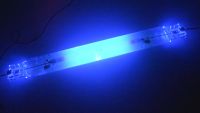
Here’s a curious ‘horticultural’ lamp displaying the interesting UV phosphorescence. The inner PCA tube glow is completely swamped by the outer envelope fluorescing with excitement from the UV being emitted. Not quite sure why they have used a UV blocking jacket considering how little UV is emitted from a HPS lamp after run up. The lamp is double ended HPS and rated at 600W.  The arc tube is thinner and about 2cm longer than a Sylvania 600W Growlux lamp I have in comparison. In total, the lamp is over 33cm. The lamp is marked 400V but also have 250V 50Hz stamped on it. It claims to be suitable for magnetic or electronic ballasts and is dimmable.
It appears to run fine on the electronic ballast I tested it with. The output from my ballast is 400v peak-peak and is square wave. But that infers a 200V supply.  It looks like my electronic ballast is at its maximum voltage output to run this lamp and has a loading of 570W so not achieving full load.   If I used this set-up as serviceable the lamp is likely to prematurely cycle.  

Keywords: Lamps

Double Ended High Pressure Sodium

Here’s a curious ‘horticultural’ lamp displaying the interesting UV phosphorescence. The inner PCA tube glow is completely swamped by the outer envelope fluorescing with excitement from the UV being emitted. Not quite sure why they have used a UV blocking jacket considering how little UV is emitted from a HPS lamp after run up. The lamp is double ended HPS and rated at 600W. The arc tube is thinner and about 2cm longer than a Sylvania 600W Growlux lamp I have in comparison. In total, the lamp is over 33cm. The lamp is marked 400V but also have 250V 50Hz stamped on it. It claims to be suitable for magnetic or electronic ballasts and is dimmable.
It appears to run fine on the electronic ballast I tested it with. The output from my ballast is 400v peak-peak and is square wave. But that infers a 200V supply. It looks like my electronic ballast is at its maximum voltage output to run this lamp and has a loading of 570W so not achieving full load. If I used this set-up as serviceable the lamp is likely to prematurely cycle.

bottles.jpg crt2.jpg uv_PCA.jpg SON_TS.jpg ThornA4_135SOX.jpg
Lamp/Fixture Information
Manufacturer:Lumenlite
Model Reference:DE HPS
Lamp
Lamp Type:HP sodium (Horticulture)
Electrical
Wattage:600W
Voltage:400V
File information
Filename:uv_PCA.jpg
Album name:Tuopeek / High Pressure Sodium
Keywords:Lamps
Filesize:482 KiB
Date added:15 May 2026
Dimensions:2500 x 1415 pixels
Displayed:295 times
DateTime Original:2026:05:14 22:41:52
Exposure Time:1/5 sec
FNumber:f/3.5
File Source:Digital Still Camera
Flash:No Flash
Focal length:18 mm
ISO:12800
Model:NIKON D3400
Software:Adobe Photoshop Elements 2.0
White Balance:0
URL:https://trad-lighting.net/gallery/displayimage.php?pid=1252
Favourites:Add to Favourites

Comment 1 to 3 of 3
Page: 1

Drew   [Fri 15 May 2026 at 13:55]
Wow that is a very bright glow! It's always interesting to see discharge lamps with voltage ratings on them, they seem to pretty much always be false. Also cool to see that the discharge tube is longer, I wouldn't think there would be that much variety in discharge tube size but I guess there are many different factors that contribute to this. Cool lamp
Tuopeek   [Fri 15 May 2026 at 14:35]
My camera has enhanced the brightness slightly but it is quite bright and easily noticed. It also persists for quite some time.

Yeah, the voltage is still confusing me, I thought maybe designed for 3-phase systems but then it says 250V 50Hz. Although that is wrong given that it runs on HF electronic dimmable ballasts.

Also curious with the arc tube being slightly thinner and longer. Made me wonder if the chemistry is different. Mercury free HPS lamps have this type of geometry change too.
Max   [Sun 24 May 2026 at 08:18]
That's a strong fluorescence there! The original type made by Philips (the SON-TD GreenPower) also has a UV-block quartz jacket because they used the same tubing as that of some compact medium-wattage CMH lamps. Also, HPS burners can produce a significant amount of ozone in the early stage of their run up phase, something that should be avoided, especially in confined spaces (greenhouses) where a large quantity of those lamps are used (by the thousands!). As for the voltage indication on the label, it's not unusual to see errors as a result of a poorly copied product, so I wouldn't take the printed information too literally. It's very likely that your lamp is designed for an operation on 400 V-mains systems (check if the arc voltage is greater than 120-150 V).

Comment 1 to 3 of 3
Page: 1