Photo Gallery

RLOD#34 (2020.06.18) 1979 Sylvania H38JA-100/N

Although Sylvania introduced its first warm-white high-pressure mercury lamps in 1973, it did not release a 100 W variant before 1977. Further technology developments were required in order to make a smaller lamp with suitable characteristics. First, the phosphor coating was improved into a more scratch resistant one which enabled a fully coated bulb. This eliminated the leakage of uncorrected bluish mercury light from the bulb crown, a part that was usually left uncoated. Second, the nature of the fluorescent material was also changed to a mix of magnesium fluorogermanate and 2nd-gen yttrium vanadate, a formulation similar to that elaborated by Westinghouse five years earlier (minus the fine silica coating). This phosphor blend, applied in a thick layer, radiates in the red end of the spectrum and absorbs part of mercury's blue light, which shifts the light color temperature to 3000 K, about 1000 K lower than that of regular fluorescent mercury lamps. The warm-white light produced this way was compatible with that of incandescent lamps and fluorescent tubes, thus facilitating its adoption in indoors and commercial/retail lighting applications.

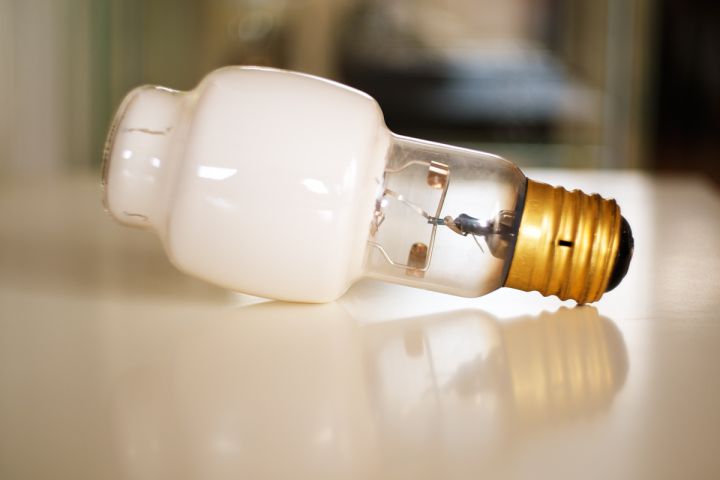
The resulting H38JA-100/N, shown here, proved superior to the company's older warm-white mercury lamps (/N and /WDX). Its bulb color has a much whiter tint than that of 1st-gen Warmtone /N lamps, it delivers a more pleasing light color, and has more stable photometric and colorimetric properties. However, like in Westinghouse's Styletone lamps, the use of a very thick phosphor coat results in significant optical losses that limits the initial lumen output to 3750 lm only, 16.7 % less than that of the standard (4000 K) bright white deluxe variant. This limitation pushed Sylvania to upgrade its Warmtone mercury lamps further, resulting in the introduction in 1980 of brighter lamps (+33 % at 100 W) coated with a blend of yttrium vanadate and yttrium aluminum garnet phosphors. However, this came at the cost of a higher light color temperature and a degraded color quality which made those lamps no longer suitable for a use in combination with incandescent lamps.


Keywords: Lamps

RLOD#34 (2020.06.18) 1979 Sylvania H38JA-100/N


Although Sylvania introduced its first warm-white high-pressure mercury lamps in 1973, it did not release a 100 W variant before 1977. Further technology developments were required in order to make a smaller lamp with suitable characteristics. First, the phosphor coating was improved into a more scratch resistant one which enabled a fully coated bulb. This eliminated the leakage of uncorrected bluish mercury light from the bulb crown, a part that was usually left uncoated. Second, the nature of the fluorescent material was also changed to a mix of magnesium fluorogermanate and 2nd-gen yttrium vanadate, a formulation similar to that elaborated by Westinghouse five years earlier (minus the fine silica coating). This phosphor blend, applied in a thick layer, radiates in the red end of the spectrum and absorbs part of mercury's blue light, which shifts the light color temperature to 3000 K, about 1000 K lower than that of regular fluorescent mercury lamps. The warm-white light produced this way was compatible with that of incandescent lamps and fluorescent tubes, thus facilitating its adoption in indoors and commercial/retail lighting applications.

The resulting H38JA-100/N, shown here, proved superior to the company's older warm-white mercury lamps (/N and /WDX). Its bulb color has a much whiter tint than that of 1st-gen Warmtone /N lamps, it delivers a more pleasing light color, and has more stable photometric and colorimetric properties. However, like in Westinghouse's Styletone lamps, the use of a very thick phosphor coat results in significant optical losses that limits the initial lumen output to 3750 lm only, 16.7 % less than that of the standard (4000 K) bright white deluxe variant. This limitation pushed Sylvania to upgrade its Warmtone mercury lamps further, resulting in the introduction in 1980 of brighter lamps (+33 % at 100 W) coated with a blend of yttrium vanadate and yttrium aluminum garnet phosphors. However, this came at the cost of a higher light color temperature and a degraded color quality which made those lamps no longer suitable for a use in combination with incandescent lamps.

2020-05-06_Philips_MPDL_35W_DV27.jpg 2020-05-14_Narva_NC400-00.JPG 2020-05-23_CDM86021V21O214K21EA21BT37.jpg 2020-06-14_Tungsram_HgMIF_25021D.jpg 2020-06-18_Sylvania_H38JA-10021N.jpg
Lamp/Fixture Information
Manufacturer:GTE Sylvania
Model Reference:H38JA-100/N
Lamp
Lamp Type:Mercury high pressure fluorescent
Filament/Radiator Type:Thermal discharge in argon and mercury vapor, fluorescence
Base:E39
Shape/Finish:Bulged tubular fluorescent
Service Life:24 kh
Burning Position:Universal
Electrical
Wattage:100 W
Voltage:130 V
Current:0.85 A
Optical
Lumen Output:3750 / 2800 lm (initial/mean)
Lumen Efficacy:37.5 / 28.0 lm/W (initial/mean)
Colour Temperature:3000 K
Colour Rendering Index:~55 Ra8
Physical/Production
Dimensions:190L x 79Ø mm
Factory Location:Manchester, NH, USA
Fabrication Date:March 1979
Application/Use:Indoors and commercial/retail lighting
File information
Filename:2020-06-18_Sylvania_H38JA-10021N.jpg
Album name:Max / Random lamp of the day
Keywords:Lamps
Filesize:338 KiB
Date added:01 Mar 2026
Dimensions:1200 x 800 pixels
Displayed:46 times
URL:https://trad-lighting.net/gallery/displayimage.php?pid=1116
Favourites:Add to Favourites

Comment 1 to 10 of 10
Page: 1

Ria   [Mon 02 Mar 2026 at 12:51]
Interesting, thanks Max. I have one of these somewhere, I think BT Clear Bander
Max   [Mon 02 Mar 2026 at 17:32]
That would be nice if you indeed have that specific lamp in your collection. This is quite a rare type as it was produced for three years only, the only one made by Sylvania that was compatible with incandescent lighting.
Tuopeek   [Mon 02 Mar 2026 at 22:52]
Never saw a warm-white mercury lamp in the wild. I would have been very inquisitive had I seen one working in the early 80s.
Ria   [Tue 03 Mar 2026 at 00:27]
@Max - Not sure now, thinking about it..! Will have to look now.
Max   [Tue 03 Mar 2026 at 06:50]
Good. Keep us updated, please. It would been nice to see some lamp uploads from you, it's been a long while.

Tuopeek - Those lamps were definitely not widely used, so the chance of finding one in the field was pretty slim (I can count all my sightings of them on one hand only).
BT25   [Wed 04 Mar 2026 at 01:52]
@Tuopeek - I've only seen these used once and that was in Canada (BC) around 32 years ago.

Nice find Max!
Max   [Wed 04 Mar 2026 at 11:38]
Thanks Eric!
Ria   [Wed 04 Mar 2026 at 18:35]
@Max - Yeah, I've been lazy lately, lots of stuff to upload, must get on with it.
BT25   [Thu 05 Mar 2026 at 00:05]
I need to upload more as well...


Max   [Thu 05 Mar 2026 at 08:01]
Looking forward to seeing/enjoying your contributions here Very Happy

Comment 1 to 10 of 10
Page: 1