|
|
RLOD#34 (2020.06.18) 1979 Sylvania H38JA-100/N
|
Although Sylvania introduced its first warm-white high-pressure mercury lamps in 1973, it did not release a 100 W variant before 1977. Further technology developments were required in order to make a smaller lamp with suitable characteristics. First, the phosphor coating was improved into a more scratch resistant one which enabled a fully coated bulb. This eliminated the leakage of uncorrected bluish mercury light from the bulb crown, a part that was usually left uncoated. Second, the nature of the fluorescent material was also changed to a mix of magnesium fluorogermanate and 2nd-gen yttrium vanadate, a formulation similar to that elaborated by Westinghouse five years earlier (minus the fine silica coating). This phosphor blend, applied in a thick layer, radiates in the red end of the spectrum and absorbs part of mercury's blue light, which shifts the light color temperature to 3000 K, about 1000 K lower than that of regular fluorescent mercury lamps. The warm-white light produced this way was compatible with that of incandescent lamps and fluorescent tubes, thus facilitating its adoption in indoors and commercial/retail lighting applications.
The resulting H38JA-100/N, shown here, proved superior to the company's older warm-white mercury lamps (/N and /WDX). Its bulb color has a much whiter tint than that of 1st-gen Warmtone /N lamps, it delivers a more pleasing light color, and has more stable photometric and colorimetric properties. However, like in Westinghouse's Styletone lamps, the use of a very thick phosphor coat results in significant optical losses that limits the initial lumen output to 3750 lm only, 16.7 % less than that of the standard (4000 K) bright white deluxe variant. This limitation pushed Sylvania to upgrade its Warmtone mercury lamps further, resulting in the introduction in 1980 of brighter lamps (+33 % at 100 W) coated with a blend of yttrium vanadate and yttrium aluminum garnet phosphors. However, this came at the cost of a higher light color temperature and a degraded color quality which made those lamps no longer suitable for a use in combination with incandescent lamps.
|
|


 Forum
Forum Gallery Home
 Contact
 Login
Login Off-Topic
 Album list
 Last uploads
 Last comments
 Most viewed
 Top rated
 My Favourites
 Search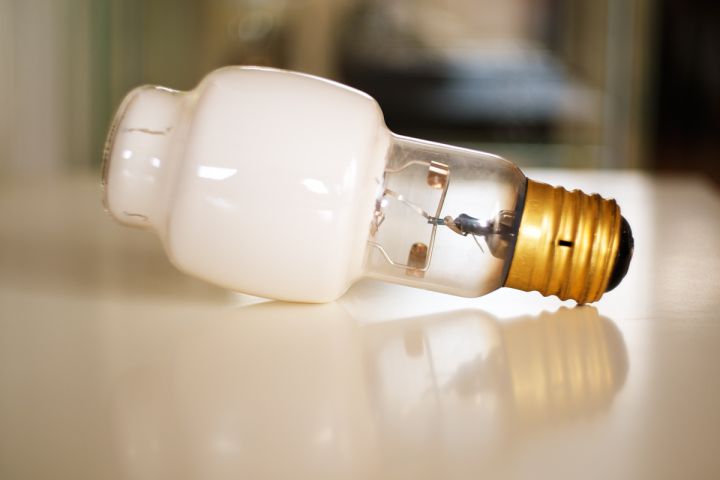


Tuopeek - Those lamps were definitely not widely used, so the chance of finding one in the field was pretty slim (I can count all my sightings of them on one hand only).
Nice find Max!