Trad-Lighting Photo Gallery

RLOD#55 (2021.01.02) 1990s Газосвет ГР-10
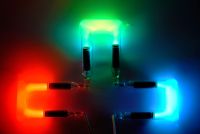
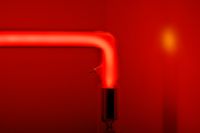
The ГР-10 series of lamps is a group of three special cold-cathode pixel discharge tubes designed and made at Газосвет in Moscow, Russia, during the 1990s for a use in large outdoor displays. These lamps were assembled by three, one for each primary color, in pixel blocks about 7 cm square. Those three lamps are the red ГР-10-К filled with neon and coated with a diffuse material such as silica or calcium pyrophosphate, the green ГР-10-З with an argon-mercury fill and a zinc silicate phosphor coating, and the blue ГР-10-С with the same fill at a lower argon pressure and coated with a calcium lead tungstate phosphor. Interestingly, all three tubes are designed with a matched brightness, adjusted via the fill pressure, so the same drive current of 10 mA could be used for all of them. This enabled the use of a simple series circuit fed by a high-OCV power supply (a minimum of 1.7 kV is required to ignite all tubes in series), with each lamp provided with a parallel switch whose state was set in order to get the desired color for each pixel block.


Keywords: Lamps

RLOD#55 (2021.01.02) 1990s Газосвет ГР-10

The ГР-10 series of lamps is a group of three special cold-cathode pixel discharge tubes designed and made at Газосвет in Moscow, Russia, during the 1990s for a use in large outdoor displays. These lamps were assembled by three, one for each primary color, in pixel blocks about 7 cm square. Those three lamps are the red ГР-10-К filled with neon and coated with a diffuse material such as silica or calcium pyrophosphate, the green ГР-10-З with an argon-mercury fill and a zinc silicate phosphor coating, and the blue ГР-10-С with the same fill at a lower argon pressure and coated with a calcium lead tungstate phosphor. Interestingly, all three tubes are designed with a matched brightness, adjusted via the fill pressure, so the same drive current of 10 mA could be used for all of them. This enabled the use of a simple series circuit fed by a high-OCV power supply (a minimum of 1.7 kV is required to ignite all tubes in series), with each lamp provided with a parallel switch whose state was set in order to get the desired color for each pixel block.

2021-01-02_Gazosvet_GR-10.jpg 2020-12-31_Janse_Lichtreclame_N58680.jpg 2020-11-29_Silec_V200.jpg 2020-11-13_Janse_Lichtreclame_10-76133.jpg 2020-09-27_Philips_FNF_50W.jpg
Lamp/Fixture Information
Manufacturer:Газосвет (Gazosvet)
Model Reference:ГР-10-К (GR-10-K red), ГР-10-З (GR-10-Z green), ГР-10-С (GR-10-S blue)
Lamp
Lamp Type:low-pressure discharge cold cathode
Filament/Radiator Type:Nonthermal discharge in neon (red) or in argon and mercury vapor plus fluorescence (green and blue)
Base:wire pigtail
Shape/Finish:π-shaped coated/fluorescent
Service Life:100+ kh
Burning Position:Universal
Electrical
Wattage:2.78 / 2.02 / 1.79 W (red/green/blue)
Voltage:280 / 244 / 213 V (red/green/blue)
Current:10 mA (all tubes)
Physical/Production
Dimensions:83-96L x 60-63W mm
Factory Location:Moscow, Russia
Fabrication Date:1990s
Application/Use:Outdoors color displays
File information
Filename:2021-01-02_Gazosvet_GR-10.jpg
Album name:Max / Random lamp of the day
Keywords:Lamps
Filesize:450 KiB
Date added:22 Nov 2026
Dimensions:1200 x 808 pixels
Displayed:15 times
URL:https://trad-lighting.net/gallery/displayimage.php?pid=1468
Favourites:Add to Favourites

Comment 1 to 6 of 6
Page: 1

Tuopeek   [Sun 22 Nov 2026 at 11:47]
I think this is a much better and more efficient design than the 3 CRT electron gun tri-colour also use in large outdoor displays. I imagine altering the intensity could be a bit difficult though. I now wonder if any one made a VFD RGB module.
Eric   [Sun 22 Nov 2026 at 15:12]
Seeing this reminds me of those old projector TV's from the late 70'/early 80's, that had those saucer plate lenses.
Max   [Mon 23 Nov 2026 at 07:13]
It's certainly the combination of saturated colors which stimulated your memory, because the shape couldn't be more different from that of those old CRT video projectors.

Tuopeek - Yes, this is definitely more efficient than CRT technology, but it has its own limitations, such as a temperature-dependent performance/brightness for the green and blue pixels. I can't imagine those pixel tubes performing well during the brutal Russian winters, especially at such low drive current as 10 mA. They should probably have gone for a UV-emitting xenon-neon fill rather than argon and mercury for those blue and green tubes, and used some tricks like e.g. clear front aperture and back reflector to maximize pixel brightness.

Also, the way those tubes were used, i.e., constant current and with parallel switches, the total color depth couldn't have been greater than 3 bits for the whole pixel block, 8 colors including black and white. That was probably good enough for a use in a data information board though.
AgentHalogen_87   [Tue 24 Nov 2026 at 16:10]
I was fooled for a moment into thinking these were all one lamp. Very cool to see primitive RGB technology
Max   [Tue 24 Nov 2026 at 22:45]
I wouldn't call it really primitive. It's certainly old, but less so than RGB systems based on colored incandescent lamps.
AgentHalogen_87   [Tue 24 Nov 2026 at 22:48]
It never crossed my mind that coloured incandescents were used. I've never seen that before either. It was only CRT or newer that I've had knowledge of

Comment 1 to 6 of 6
Page: 1